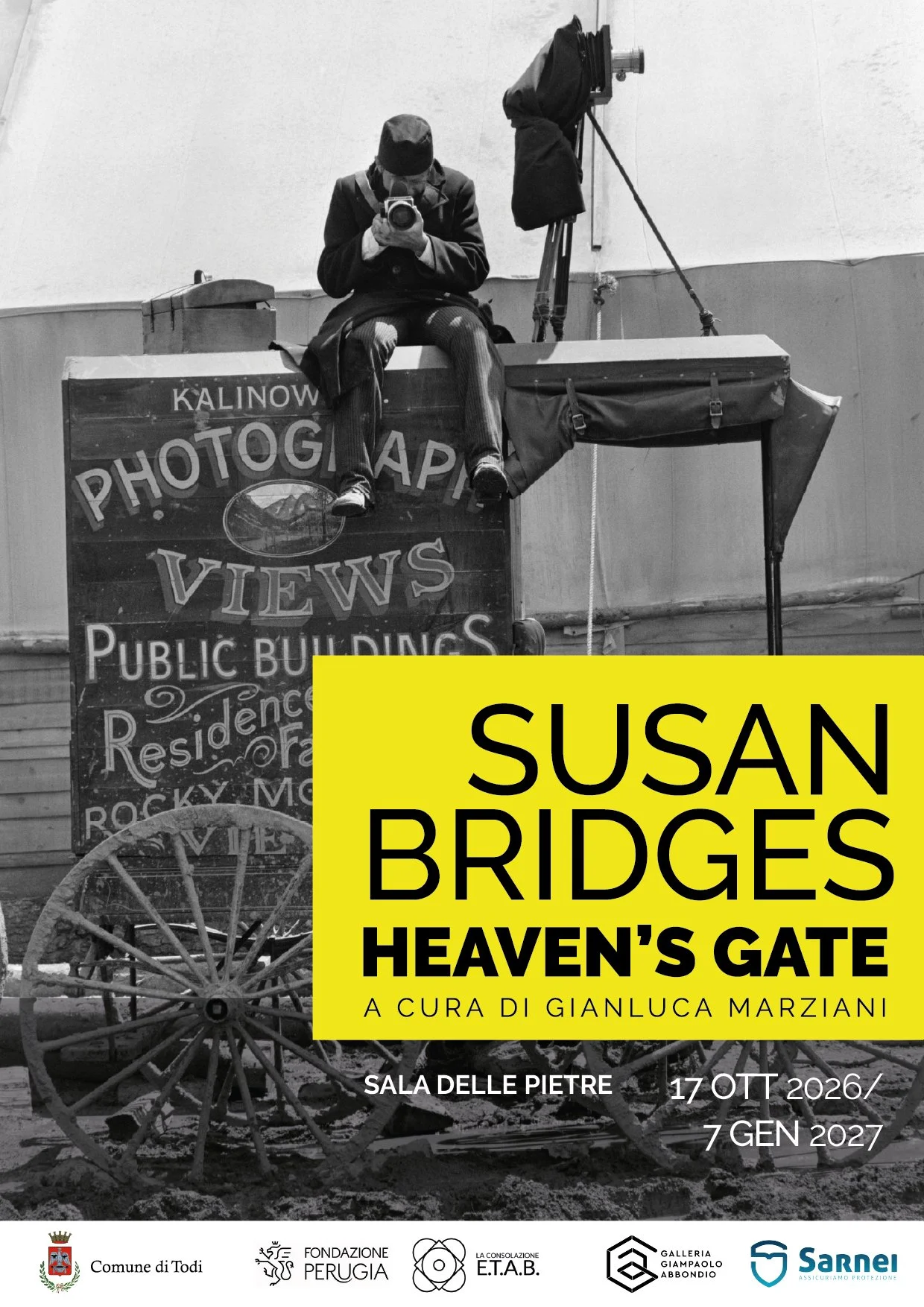
SUSAN BRIDGES — HEAVEN’S GATE
Gianluca Marziani | Curator
Susan Bridges is an American photographer, known for her artistic work as well as for her many organizational and production activities, including the founding of a company to support Widelux, a panoramic camera capable of producing truly unique images. At a young age, she studied Photography at the Art Center College of Design and the California Institute of the Arts, two formative institutions where openness of meaning and a multidisciplinary approach intersect, in keeping with the distinctive West Coast tradition, where the visual arts move across boundaries and hybridize, freeing themselves from the overly rigid methodological standards that so often make creativity dogmatic and monocentric. Susan Bridges is married to actor Jeff Bridges, one of the protagonists of Heaven’s Gate, the film from which our story begins, in the form of an exhibition and a book: a remarkable story that brings to Todi the collective memory of a cinema that has now become part of the History of the twentieth century.
Heaven’s Gate is a feature film, but also a widespread cult object, a masterpiece and, at the same time, a gigantic epochal flop, an utopia but also a lesson in filmmaking, probably one of those narrative enigmas that reveals much about Hollywood, but also about the birth of the United States, about the origins of a frontier that carried history from the myth of conquerors toward the literature of pioneers.
Heaven’s Gate is one of the most radical episodes in the history of Hollywood: an extraordinarily ambitious film, 219 minutes long, directed by an uncompromising giant such as Michael Cimino, a high-budget United Artists production that became one of the most colossal flops in the history of cinema. A film that seems like a journey beyond time, a cinematic capsule in which the making of the film itself became a substantial part of a human and poetic odyssey, almost the natural sibling of Apocalypse Now, the other masterpiece in which human determination and titanic genius exceeded the limits of productive pragmatism.
The exhibition in Todi is a surprise that blends cinephile culture with the language of still photography, capturing the iconographic power of Cimino’s frames and the painterly quality of his metaphysical Western, transforming them, through Susan’s impressionistic eye, into a series of panoramic frames that seem steeped in the atmosphere of nineteenth-century French landscapes, in the pulsating skies with their Baroque volumes, and in bodies that became living sculptures within an electric yet Edenic landscape. Susan Bridges has captured the epic quality of natural atmospheres, the dramaturgy of the human condition, the immensity of the open frontier, the anomalous details concealed by the filming, and the intensity of events that mingled art and life in one of those rare moments of total symbiosis, when a mythology is being created with the attitude of legendary virtue.
Susan Bridges has accomplished a rare feat: she has made still photography an independent object, a kind of static counterbalance within the dynamic project of the motion-picture camera, a close encounter between the sequential order of filming and the photographer’s freedom of movement during the shooting days. We can imagine, as though we were a drone traveling through time, the physical distances between director and photographer, their optical positions on set, and the intersection of visions between the man who was filming and the woman who was taking photographs. The result is striking for the narrative and formal power of the images, as if the heart of photography had become a second anthropological Western, in which the lunar immensity of the set generated further effects of estrangement, with a pronounced metaphysical dimension, entirely understandable in the case of a work shaping visual archetypes of anthropological foundation.
At the heart of it all lies the idea that made this result possible: the choice to use black and white in contrast with the film’s color palette, splitting the scenes through a semantic shift that lowers the aesthetic temperature, playing the many keys of nuanced gray, of tones that are more or less warm in light and darkness. A courageous and highly personal choice, an exceptional rendering born from a rare combination of limitations and possibilities.
An exhibition that is a journey within a journey, a photographic eye following Cimino’s traces in order to double the optics and invent a visual novel on photographic paper. The exhibition space itself emphasizes the horizontality of the panoramas, the length of the frontiers, that forward movement which the photographs convey with vivid sensations. Panoramas, portraits, and group scenes provide us with the film’s visual cadence in an exhibition synthesis of the fixed moment, the moment that does not flee but instead takes root in the time of the negative and becomes an archaeological photography for the near future.
What is particularly astonishing is the emotional force radiating from the portraits and certain collective moments, when facial expressions and movements of the body captured a sense of primordial courage, of confrontation with Nature, of fears but also overflowing passions, of naïveté and existential primogeniture connecting characters and personalities. All of this can be felt when looking at the photographs; one can almost sense the smell of sand and sweat, the heat clinging to clothes, a mixture of wounds and healings, apparent normality and spreading madness, possible beauty and necessary horror.
Susan Bridges has treated the elements of the set with a harmonic and melodic sensibility, capturing the iconographic intensity of the frame, the instant of the climax held in balance, the seamless current flowing between places and gestures. Here are the actors and actresses who would later become Oscar-winning faces, supporting actors and extras whose physiognomic acuity recalls the perfectly chosen types of Fellini, sheds and other interiors pulsating with nomadism and titanic challenge, the weather itself, which might have deserved a credit in the opening titles… and then the cinematography of Vilmos Zsigmond, onto which Susan’s parallel vision was grafted: a magnificent photographic double which, in this case, with a rare and precious quality, produced unique and extraordinary images, now transformed into an exhibition and a book.
A kolossal film and a photographic portfolio that define the profound meaning of the American myth, tracing the construction of a new Nation where everything was still possible, where ingenuity and madness conversed within utopias that ambition could place within reach. The film itself proved to be an extraordinarily complicated utopia, a broken dream that only time has liberated in its purely cultural value, expanding the historical significance of an undertaking we may describe as Homeric. A true Odyssey in the time of the Western frontier, an origin and a destiny that Susan Bridges’s photographs return to us in the best possible form.
The form of duration and inexhaustible poetry.